


Vivienne Westwood Corsets: The History Behind Her Most Iconic Designs
Vivienne Westwood Corsets: The History Behind Her Most Iconic Designs
Époque Couture · Published 30 October 2026
Few garments are as closely associated with Vivienne Westwood as the corset. First introduced in its recognisable modern form in her Autumn/Winter 1987–88 Harris Tweed collection, it became a recurring element in her work. Westwood took the construction of eighteenth-century stays, adapted it using modern fabrics and fastenings, and presented the corset as a garment to be worn in its own right.
Her designs combined historical garments with references to fine art, particularly the paintings and decorative arts of eighteenth-century France. The Portrait corset, printed with François Boucher's Daphnis and Chloe, remains one of her most recognisable creations. Other designs incorporated elaborate Baroque ornament, photographic imagery, velvet, lace and denim.
More than thirty years after their introduction, original Vivienne Westwood corsets remain highly sought after by collectors. Examples are held in major museum collections, including the Victoria and Albert Museum, the Metropolitan Museum of Art and the National Gallery of Victoria. They have also found a new audience through musicians, actors and models, among them the Kardashians, BLACKPINK's Lisa, FKA twigs, Bella Hadid and Kate Moss.
From Punk to Historical Dress: The Origins of Westwood's Corsets
Vivienne Westwood began exploring the relationship between clothing, sexuality and convention during the 1970s, when she worked with Malcolm McLaren at their shop at 430 King's Road in Chelsea. The shop underwent several changes of name and identity, including SEX, which opened under that name in 1974. The clothing sold there borrowed elements from fetishwear, including bondage trousers, rubber garments and underwear worn visibly as outerwear. Corsetry was part of this early interest in exposing garments that had traditionally remained concealed.
By the early 1980s, Westwood's work had moved in a different direction. She began studying historic dress, visiting museums and examining construction techniques that had largely disappeared from modern fashion. Her interest extended beyond the appearance of historical clothing to the way garments were cut, assembled and used to alter the proportions of the body.
The Mini-Crini collection of 1985–86 was an important stage in this development. Westwood shortened the nineteenth-century crinoline into a bell-shaped miniskirt, retaining the underlying construction of a historical garment while changing its proportions and purpose. The corset received a similar treatment.
In 1987, Westwood introduced a new interpretation of eighteenth-century stays in her Harris Tweed collection. The design, known as the Stature of Liberty corset, was based on a bodice that she had studied with the assistance of her friend and mentor Gary Ness.
Eighteenth-century stays were often made with numerous stiffened panels and tightly laced fastenings. They supported and raised the bust, controlled the waist and established the fashionable posture of the period. Westwood retained the recognisable shape but made several practical changes. She introduced elasticated side panels, used flexible synthetic boning and replaced traditional lacing with a zip fastening. These adjustments allowed the corset to move with the body more readily than its historical predecessors. Crucially, she also removed its function as concealed underwear: the corset became the outfit itself.
Malcolm McLaren and Vivienne Westwood. Source: London Museum
The Stature of Liberty Corset, 1987–1988
The Stature of Liberty established the basic construction that Westwood would revisit for much of her career: a shaped front panel, a raised bust, wide shoulder straps, a narrow waist and a pointed lower edge.
For the Autumn/Winter 1988–89 Time Machine collection, she developed the design further, including versions made in metallic leather. Westwood was fascinated by the clothing of eighteenth-century European society, particularly its treatment of the bust, waist and hips. Yet her corsets were not intended to reproduce it faithfully. She was interested in taking an existing form and modernising it. The name Stature of Liberty also expressed her rejection of the idea that corsetry necessarily had to represent restriction. In Westwood's interpretation, a woman could choose to wear a corset visibly, as an expression of her own appearance rather than as an obligatory foundation beneath her clothes.
It is important not to oversimplify the history of corsetry. Historical corsets served different purposes in different periods, and women's experiences of wearing them varied considerably. Westwood's contribution was not the invention of the corset as fashion, but the development of a particular modern version that became influential in late twentieth-century design.
The Portrait Corset: Vivienne Westwood and François Boucher
In Autumn/Winter 1990–91, Westwood presented Portrait, one of the most important collections of her career. The collection was inspired by the paintings, furniture and decorative objects of the eighteenth century, with particular reference to London's Wallace Collection. Westwood had spent considerable time studying the museum's holdings, which include French Rococo paintings by François Boucher and Jean-Honoré Fragonard, as well as furniture and objects associated with the French court.
For Portrait, she began reproducing the art directly onto clothing. The best-known example is the Vivienne Westwood Portrait corset, featuring François Boucher's Daphnis and Chloe, also known as Shepherd Watching a Sleeping Shepherdess, painted around 1743–45.
François Boucher (1703–1770), Daphnis and Chloe, 1743. Oil on canvas. The Wallace Collection, London (P385). Courtesy of The Wallace Collection.
The original painting depicts Daphnis watching the sleeping Chloe in a pastoral landscape. Westwood reproduced part of the composition across the front of a corset, placing the painted figures over the wearer's torso. The surrounding shoulder straps were decorated with classical ornamental motifs, giving the impression that the painting had been placed within a gilded frame.
This was an unusually literal use of art in fashion. Rather than taking inspiration from the colours or composition of a painting, Westwood transferred the artwork onto a garment whose construction was itself derived from the same historical period. The result brought together two of her principal interests: eighteenth-century dress and eighteenth-century art. (See the house's own account in Westwood Heritage: Boucher and Beyond.)
The corset appeared on the Portrait runway in a memorable presentation during which models Susie Bick and Sara Stockbridge, both wearing Boucher corsets, linked arms and kissed.

Portrait, Autumn/Winter 1990–91
The design also became one of Westwood's most extensively documented museum pieces. An original 1990 example belongs to the Victoria and Albert Museum, while other versions are represented in collections including the National Gallery of Victoria and the Powerhouse Collection in Australia.
Époque Couture holds a re-edition of the Vivienne Westwood Portrait Corset.

The Boulle Print: Decorative Art Translated into Fashion
The Boucher corset was not the only important design to emerge from the Portrait collection. Westwood also developed what became known as the Boulle print, inspired by the elaborate decoration of a mirror associated with André-Charles Boulle, the French cabinetmaker who worked for Louis XIV.
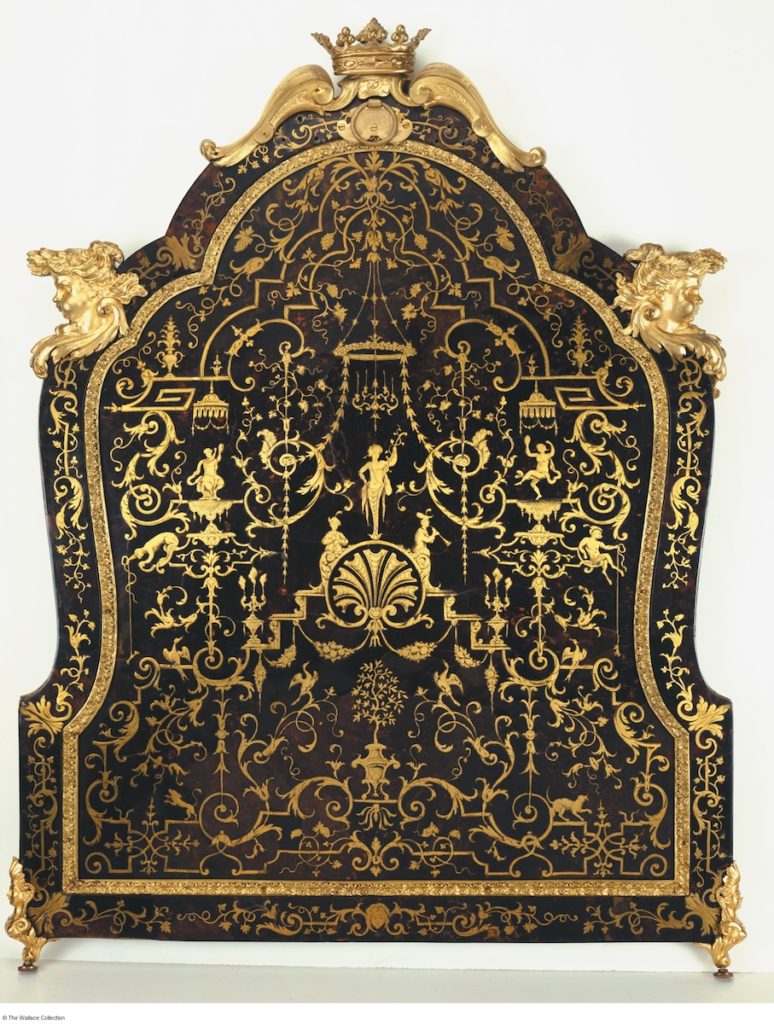
Toilet mirror, 1713. French, with brass and tortoiseshell Boulle marquetry. The Wallace Collection, London (F50). © The Wallace Collection.
The mirror, dating to 1713 and held at the Wallace Collection, features elaborate ornamental decoration. Westwood adapted its imagery into a textile design, incorporating scrolling foliage, classical figures, fantastical creatures and gilded architectural details. The print was particularly effective on dark fabrics, where the metallic decoration resembled the surface of an antique object.
Unlike the Boucher corset, which displayed a recognisable painting, the Boulle designs used repeated ornamental elements to cover the garment. The print appeared on dresses, leggings, bodysuits and corsets throughout the early 1990s, often in different fabrics and colourways.
 |
 |
 |
Important examples in the Époque Couture archive are the Vivienne Westwood Black Velvet Boulle Print Long-Sleeve Corset (AW 1990) and the Vivienne Westwood Boulle Velvet Dress (AW 1990).
A related Double-Layered Boulle Print Corset from the 1990s offers another variation. Its printed inner corset is partially covered by a draped, shimmering black viscose layer, with the historical ornament visible beneath.
A later version of the print, from the Autumn/Winter 1991–92 collection, appears on the Vivienne Westwood Boulle Print Cotton Mini Dress (AW 1991).

Velvet Corsets and the Dressing Up Collection, 1991
By the beginning of the 1990s, the corset had become an established part of Westwood's collections. The Autumn/Winter 1991–92 Dressing Up collection continued her exploration of historic dress, combining fitted corsets with exaggerated proportions, short skirts and richly textured fabrics. Velvet proved particularly suitable for these designs. Its dense surface accommodated the shaping of the corset and recalled the materials found in historical portraiture.
The Vivienne Westwood Black Velvet Corset (AW 1991), held by Époque Couture, illustrates the construction used during this period.
It has a shaped velvet front with boning through the front and back, black cotton jersey side panels, wide shoulder straps and a pointed lower edge. The stretch panels are an important part of the design. Although the front has the appearance of a traditional rigid corset, the jersey allows the garment to accommodate movement. A related Blue Velvet Corset, dating to around 1991, uses the same basic construction in royal blue velvet with contrasting black jersey sides.
 |
 |
These designs demonstrate why Westwood's corsets became so adaptable. Their strong shaping did not depend on elaborate decoration. Even in plain velvet, the proportions remain recognisably her own.
The black velvet style is also associated with Kate Moss's early party wardrobe, while Kim Kardashian has subsequently worn a blue velvet version.
Always on Camera, 1992: Corsets, Denim and Photographic Prints
For Autumn/Winter 1992–93, Westwood presented Always on Camera, a collection inspired by the appearance and self-presentation of Hollywood stars, particularly Marlene Dietrich. The collection was developed with Andreas Kronthaler, who would become Westwood's long-standing creative partner and husband.
Dietrich's carefully constructed screen image offered Westwood a new source of inspiration. The collection combined tailored suits, corsets, denim and exaggerated proportions, often incorporating photographic imagery. Westwood and Kronthaler manipulated images of Dietrich, fragmenting and repositioning them across clothing. Denim became a particularly important material in this process. The collection also featured lace-effect printing, metallic threads and decorative trompe-l'œil techniques.
Two corsets in the Époque Couture archive come from Always on Camera.
The first is a Vivienne Westwood Rolls-Royce Print Denim Corset (AW 1992). Its front panel incorporates an abstracted image of a Rolls-Royce, including the Spirit of Ecstasy mascot. Contrasting denim washes and red topstitching divide the garment into visible sections. The corset was documented on the Autumn/Winter 1992–93 runway and comes from the wardrobe of Annabelle Neilson, the British socialite and close friend of Alexander McQueen.
The second is the Vivienne Westwood Lace-Print Corset (AW 1992). Made from black tulle printed with glittered green and blue Venetian lace motifs, the garment creates the appearance of decorative lace through printing. A version of this design appeared on the runway in a different colour.
 |
 |
Both pieces demonstrate Westwood's interest in trompe-l'œil. The denim corset treats photography as a textile design. The lace-print corset imitates a decorative fabric. Each uses the same underlying garment as a surface for a different visual experiment.
Storm in a Teacup, 1996: The Lace Corset
Westwood continued to develop corsetry throughout the middle of the 1990s. Her Autumn/Winter 1996–97 collection, Storm in a Teacup, explored asymmetry, altered tailoring and garments whose conventional construction had been deliberately rearranged. The runway featured jackets with displaced fastenings, skirts and trousers combined into unexpected shapes, and dramatic eveningwear. Corsetry remained part of this exploration, although the materials and proportions had changed considerably since the Harris Tweed collection.
Époque Couture holds a Vivienne Westwood Chantilly Lace Corset from Autumn/Winter 1996. The corset is constructed from black Chantilly lace and has an asymmetrical one-shoulder neckline, internal boning, diagonal lace draping and a black satin bow at the back shoulder. Davina McCall wore a version at the 1996 MTV Europe Music Awards, and the style has subsequently appeared on Kourtney Kardashian and Ariana Grande.

Époque Couture's example also has personal provenance: it is the second piece in the Époque archive from the wardrobe of Annabelle Neilson.
Vivienne Westwood Corsets in the Late 1990s and Early 2000s
By the late 1990s, corsetry had become a regular part of the Westwood wardrobe. The designs were no longer limited to short, recognisably historical bodices. Internal boning could be incorporated into fitted tops, dresses and garments with draped or asymmetric necklines.
A Purple Draped Corset Top from the late 1990s or early 2000s, held by Époque Couture, demonstrates this later development. Made from purple viscose jersey, it has a draped cowl neckline, long fitted sleeves and an internal boned corset. The pointed hem retains a reference to the earlier designs, but the draped fabric gives the garment a different appearance. The construction is not immediately apparent from the outside, particularly when compared with the exposed shaping of the Portrait corset.
Another example is Époque Couture's Black and Purple Lace Corset Top from the early 2000s. The top has alternating panels of black and purple lace with a square neckline, short elasticated sleeves and a lace flounce. Its internal boning provides the fitted shape beneath the decorative exterior. A white lace dress with similar neckline and sleeve details appeared on the runway for Westwood's Spring/Summer 2002 collection.
 |
 |
Who Has Worn Vivienne Westwood Corsets?
The history of Vivienne Westwood corsets extends well beyond the original runway presentations. Their association with musicians, models and public figures has helped sustain interest in the designs, particularly among younger collectors.
Kate Moss
Kate Moss has long been associated with Westwood's work, and her appearances in velvet corsetry during the 1990s remain an important part of the designer's fashion legacy.
FKA twigs
In 2019, FKA twigs wore a vintage Boucher Portrait corset to the Sundance Film Festival.
Later that year, she collaborated with stylist Matthew Josephs and photographer Roxy Lee on an editorial for her digital publication Avantgarden. The photographs were taken inside London's Wallace Collection, bringing Westwood's corsets back to the museum whose paintings and decorative objects had inspired their creation. The editorial included pieces from her personal archive alongside borrowed vintage garments.
Bella Hadid
Bella Hadid wore an archival Boucher-print corset featuring Hercules and Omphale in 2019, styling it with contemporary trousers and accessories.
Kim Kardashian
Kim Kardashian has worn several vintage Westwood pieces, including velvet corsets. Her appearances in a blue velvet style helped introduce the early 1990s construction to a wider contemporary audience.
Lisa Manoban
BLACKPINK's Lisa wore a Boulle-print Westwood design in the music video for her solo single Lalisa, released in 2021. Its gilded ornament brought renewed attention to Westwood's early 1990s decorative prints.
Davina McCall, Kourtney Kardashian and Ariana Grande
The asymmetric black lace corset from Storm in a Teacup provides another example of a historical design continuing to be worn across several decades. Davina McCall wore the design in 1996, while later appearances by Kourtney Kardashian and Ariana Grande have contributed to its renewed visibility.
The continued use of these pieces is significant. Unlike many vintage garments that remain closely associated with their original decade, Westwood corsets are regularly worn with contemporary clothing. Their construction makes them recognisable, but their styling has never been limited to one particular period.
Why Are Vivienne Westwood Corsets Considered Iconic?
Westwood's corsets are historically important for several reasons.
First, they helped restore the corset to a prominent place in modern fashion. Westwood was not alone in exploring underwear as outerwear, and designers including Jean Paul Gaultier were also developing influential interpretations during the 1980s. Her particular contribution was to return to the construction of eighteenth-century stays and adapt it for contemporary dress.
Second, the corsets demonstrate her unusually sustained interest in historical clothing. The design was not simply intended to resemble an older garment. Its proportions, panels and shaping were studied and then altered.

Vivienne Westwood, Vive la Cocotte, Autumn/Winter 1995–96
Third, the corsets became a means of incorporating art history into clothing. The Boucher and Boulle designs remain important examples of Westwood's practice of reproducing images and decoration from museum collections.
Finally, the corsets developed into a recognisable part of her work over several decades. The basic construction survived through changes in fabrics, prints, styling and creative direction. Their influence can be found in the wider resurgence of corsetry during the 1990s and in its continued popularity today. The design has also become an important part of Westwood's present-day collections, including ready-to-wear and bridal gowns. Contemporary versions continue to refer to the construction she established in the late 1980s.
Vivienne Westwood Corsets in Museum Collections
The presence of Westwood corsets in major museum collections reflects their importance within the history of late twentieth-century fashion.
The Victoria and Albert Museum in London holds an original Portrait corset from 1990, printed with François Boucher's Daphnis and Chloe. The museum also holds Westwood garments from the Time Machine and other historically influenced collections.
The National Gallery of Victoria in Melbourne holds a number of significant Westwood designs, including examples from Portrait and Always on Camera.
The Powerhouse Collection in Australia also includes a 1990–91 Boucher corset, accompanied by documentation of its original owner and the circumstances in which it was purchased and worn.
The Metropolitan Museum of Art in New York has collected Westwood's work, including corsetry and designs from the early 1990s.
These institutional holdings allow researchers to study the garments beyond runway photography. They document construction, fabric composition, historical references and the development of individual designs.
Vivienne Westwood Corsets at Époque Couture
The Époque Couture archive brings together several important examples of Vivienne Westwood corsetry, spanning the early 1990s through the following decade. The collection includes the Boucher Portrait design, Boulle-print corsets, original velvet styles and runway-documented pieces from Always on Camera.
Among the earliest examples are the Black Velvet Corset (AW 1991) and Blue Velvet Corset (c. 1991). Both retain the characteristic boned construction, wide straps and stretch side panels associated with Westwood's early corsetry.
The archive also includes two interpretations of the Boulle print: the Black Velvet Long-Sleeve Corset and the Double-Layered Boulle Corset, which combines the ornamental print with a shimmering draped overlay.
The Portrait Corset re-edition preserves one of the most important designs in Westwood's history.
Two pieces from Autumn/Winter 1992–93, the Rolls-Royce Print Denim Corset and Lace-Print Corset, document the experimentation with photography, denim and printed textiles in Always on Camera.
The Chantilly Lace Corset (AW 1996) represents the later development of Westwood's asymmetric construction and has provenance from the wardrobe of Annabelle Neilson.
Finally, the Purple Draped Corset Top and Black and Purple Lace Corset Top illustrate how corseted construction continued into Westwood's later designs.
Together, these garments provide a record of the corset's development across different collections, fabrics and historical references. They also demonstrate why the original designs remain important to fashion historians and collectors. What began as Westwood's reinterpretation of an eighteenth-century undergarment became one of the most recognisable forms in modern British fashion.
View Vivienne Westwood in the Époque Couture archive.
Please contact Époque Couture for enquiries.
Époque Couture is an independent archival fashion dealer and is not affiliated with, authorised by, endorsed by, or officially connected with Vivienne Westwood or its trademark owners.
