


Alexander McQueen's Joan Collection Autumn/Winter 1998
Martyrdom, armour, and the sequinned "Drei Mädchen" print
By early 1998, Alexander McQueen was twenty-eight and three years into his own label, having already built a reputation for confrontational shows. Joan, his twelfth collection, was staged on 25 February 1998 at the Gatliff Road Warehouse in London. McQueen barred several tabloid journalists from attending, a decision that resulted in a hostile editorial response from at least one of them in the days after.
The collection took its name and its central reference from Joan of Arc, the fifteenth-century French saint burned at the stake for heresy in 1431. McQueen was drawn to the woman behind the legend rather than the myth itself, later telling Tim Blanks that he wanted to understand the mentality behind an act of that scale, and that he had always looked to strong women for inspiration. The collection was dedicated to his friend and muse Annabelle Neilson.
 |
 |
 |
The palette was built around red, black, and silver, colours chosen to evoke warfare, blood, and flame. Ecclesiastical references ran through the tailoring, and medieval armour was reinterpreted as eveningwear: several looks in chainmail-effect fabric, and at least one ensemble incorporating genuine silver-plated armour pieces. Ninety-one looks were shown in total, predominantly womenswear with a smaller run of menswear.
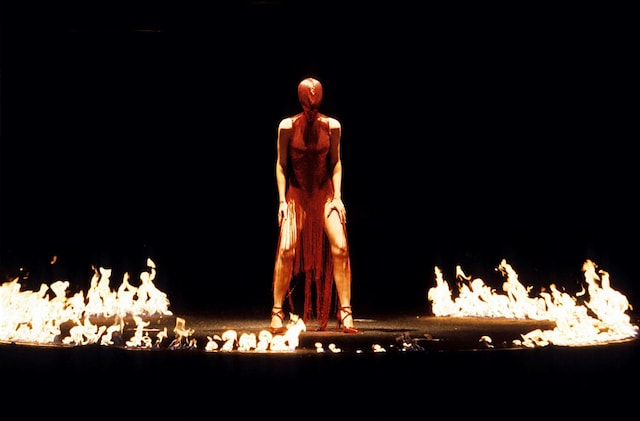
The staging matched the clothes. A hundred-foot runway was covered in black ash, lit by industrial lamps suspended overhead, with models entering through a black backdrop lit from behind in red. Models wore red contact lenses and severe, medieval-inflected hairstyles, some bald with braids obscuring the face. The show closed with the model Svetlana in a red beaded dress that covered her features entirely, standing at the centre of the runway as a ring of fire ignited around her.
A recurring motif through the collection was a sequinned photographic print of three seated girls, applied across coats and separates and rendered almost entirely in dark sequin work. The image is widely and incorrectly described as a portrait of the Romanov sisters. It is in fact "Drei Mädchen" ("Three Girls"), a daguerreotype taken in 1845 by Carl Gustav Oehme, predating the Romanov murders by more than seventy years. Examples of the print are held in the permanent collections of the Metropolitan Museum of Art and the Victoria and Albert Museum.
The Epoque Couture archive holds two pieces carrying this print: a sequinned evening coat with a high funnel neckline, and a short-sleeved sequin top with the same image extending across its front and back panels. Both are fully documented and available in the archive.
